






Swipe to explore the illustrated story.
Saved stories stay on this device.
Read the story
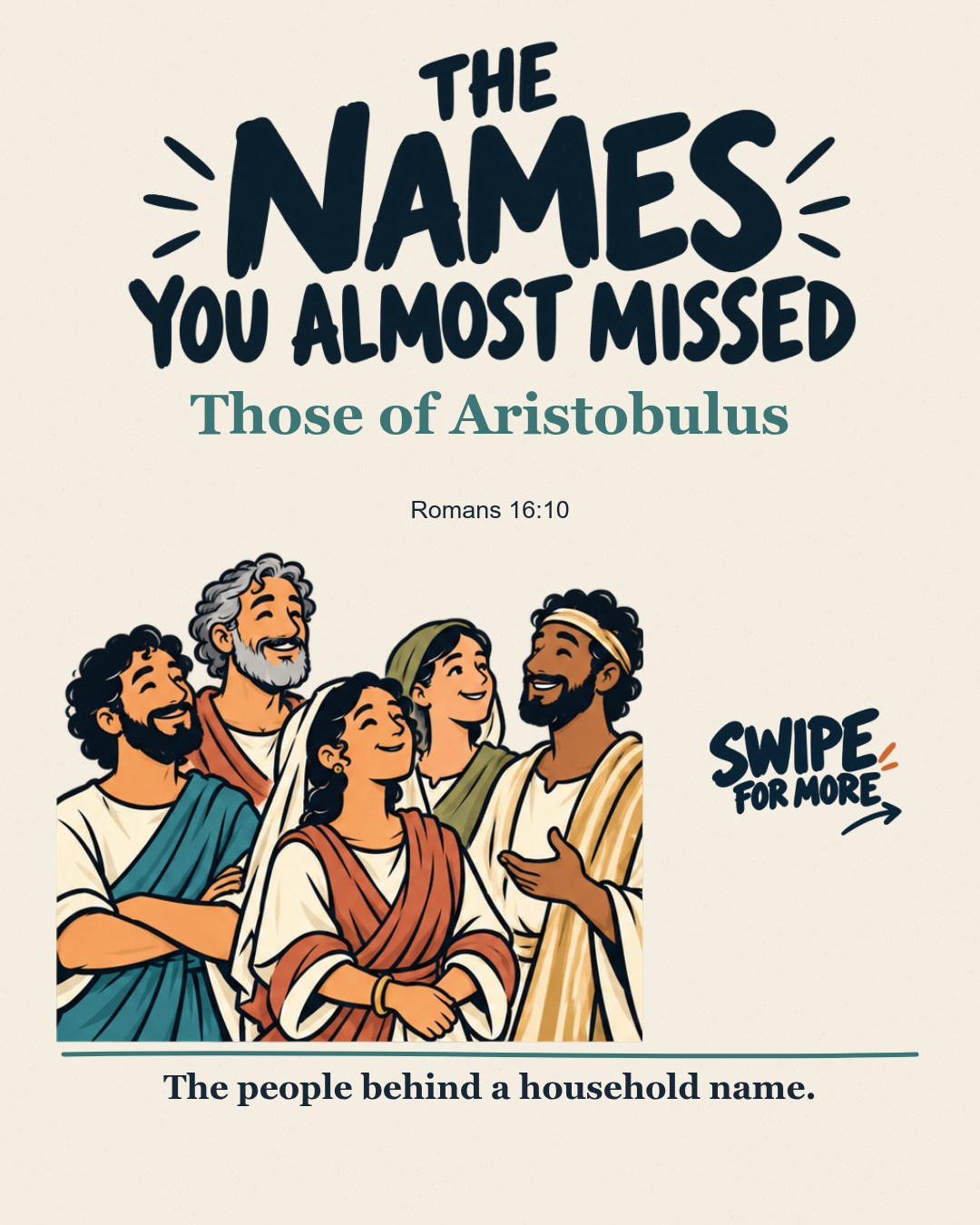
The people behind a household name.
Those of Aristobulus • Romans 16:10
Illustrative portrait / group
Read the greeting.
“those who belong to the family of Aristobulus”
Romans 16:10 (ESV) • excerpt
The greeting is to them.
Paul greets people associated with Aristobulus. He does not individually greet Aristobulus or tell us whether Aristobulus himself believed.
Romans 16:10; see source notes
More than a household label.
Their names are not supplied to us. The household reference points to real people the recipients could recognize; their lives must not disappear behind its identifying name.
Romans 16:10; see source notes
A household is not necessarily a nuclear family.
The ESV uses family. The underlying group designation does not let us draw a particular father, mother and children—or assign anyone an exact legal status.
Historical context and limits • source notes
A person within the group.
People identified collectively still matter personally. Jesus’s care for his own helps us see why a name absent from our records is no measure of a person’s worth.
Romans 12:4–5,10; 16:10; John 10:3 • comparison
Give personal attention.
Think of someone usually introduced through a team, household or institution. Address them by their own name and ask about their life, beyond the label you already know.
A present-day invitation
Whose name comes to mind?
Whose own name and story would you like to learn? Share a first name and a true memory, if you’d like. A private thank-you matters, too.
Names matter because people matter.
Explore the book
Romans — The Gospel of God and the People He Calls by Name. Landon Key. romansbook.com
Explore the book • romansbook.com