






Swipe to explore the illustrated story.
Saved stories stay on this device.
Read the story
Paul remembered her motherly care.
Rufus’s mother • Romans 16:13
Illustrative portrait / group
Read the greeting.
“his mother, who has been a mother to me as well”
Romans 16:13 (ESV) • excerpt
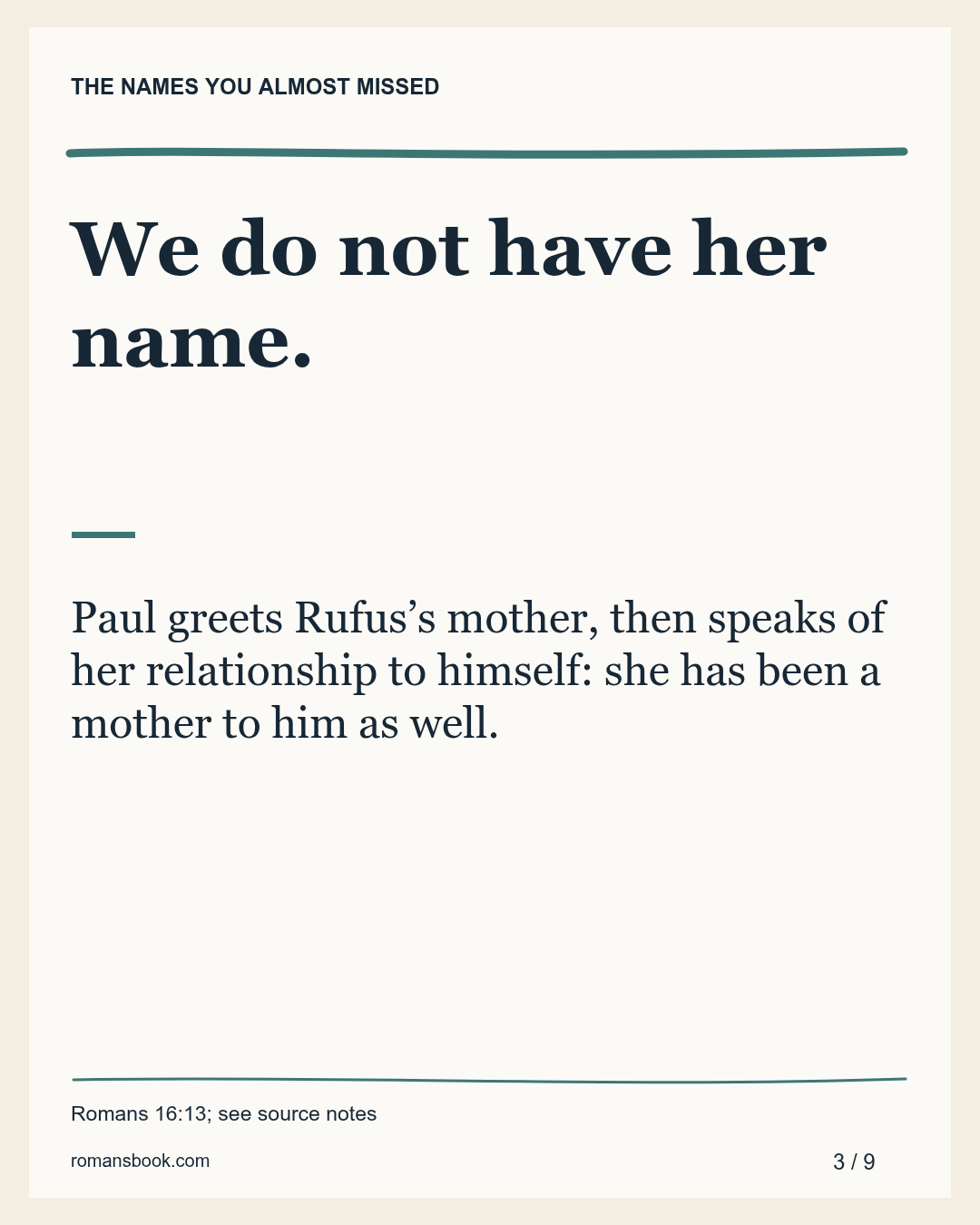
We do not have her name.
Paul greets Rufus’s mother, then speaks of her relationship to himself: she has been a mother to him as well.
Romans 16:13; see source notes
Paul remembered the relationship.
Her name is absent from our reading, yet Paul remembers her as a mother to him. Her care mattered within a relationship we cannot fully reconstruct.
Romans 16:13; see source notes
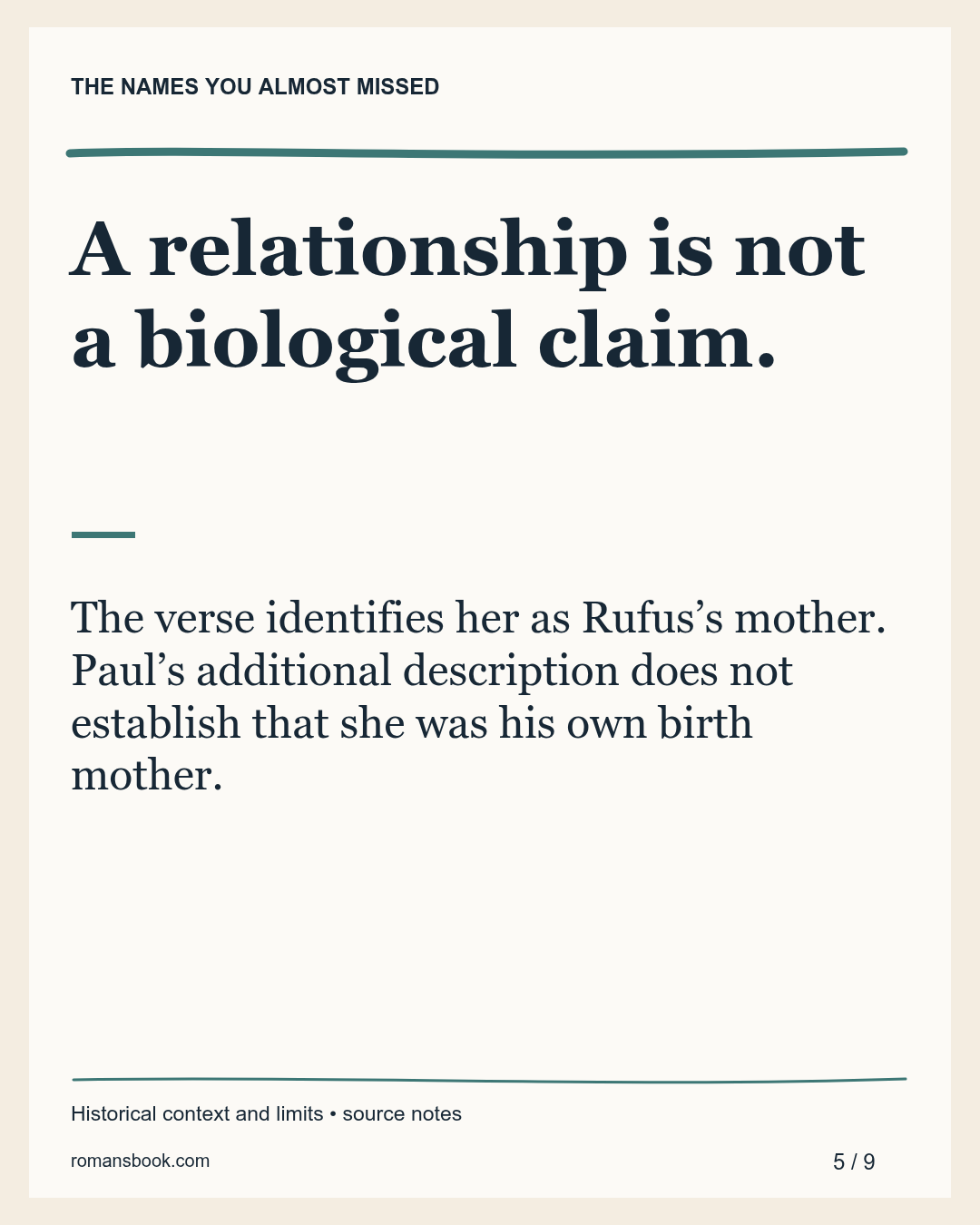
A relationship is not a biological claim.
The verse identifies her as Rufus’s mother. Paul’s additional description does not establish that she was his own birth mother.
Historical context and limits • source notes
The weight of personal care.
Love takes another person’s good seriously. Her greeting invites us to consider the lasting weight of personal care, even when the details never reach a wider audience.
Romans 12:10; 16:13; Philippians 2:3–4 • comparison
Be present to someone nearby.
Who we are to the people nearest us deserves our care. Honor someone whose steady affection has helped you, then consider how you can be present to another person.
A present-day invitation
Whose name comes to mind?
Whose care stays with you, though most people have never heard their name? Share a first name and a true memory, if you’d like. A private thank-you matters, too.
Names matter because people matter.
Explore the book
Romans — The Gospel of God and the People He Calls by Name. Landon Key. romansbook.com
Explore the book • romansbook.com